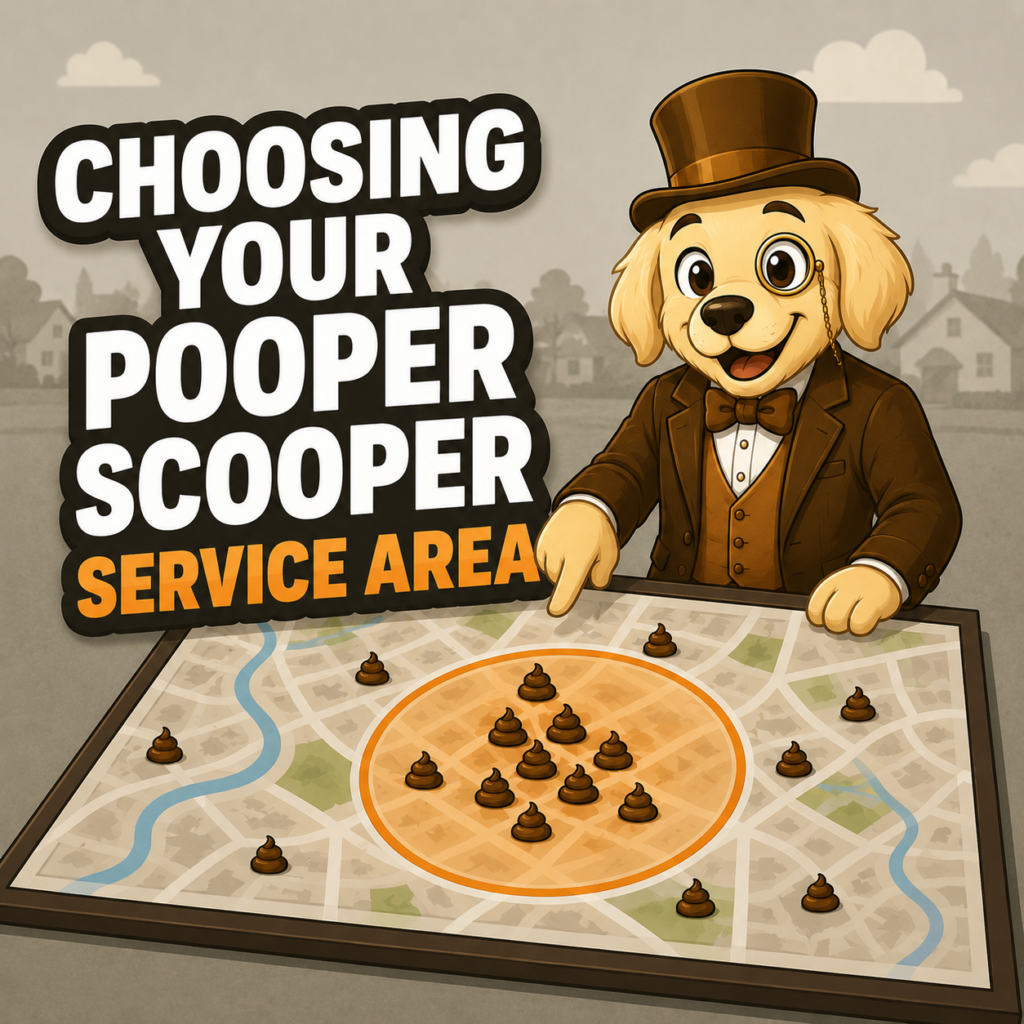
Choosing your service area is one of the most important decisions you will make when starting a pooper scooper business.
A larger service area gives you more potential customers to market to, but it can also create too much drive time. A smaller service area can make routes more profitable, but it may limit how many customers you can reach when you are first getting started.
The goal is to choose a service area that gives you enough room to grow without spreading your routes so far apart that drive time kills your profit.
If you are still working through the basics of launching your business, you may also want to read our full guide on how to start a pooper scooper business.
Quick Answer: How Big Should Your Pooper Scooper Service Area Be?
A good pooper scooper service area should usually be tight enough that you can drive across the entire area in about 45 minutes or less.
From there, you can divide that larger service area into smaller route sections or service days. Ideally, each route section should be compact enough that a technician can drive from one side of that day’s service area to the other in about 15 minutes or less.
That does not mean every stop will be 15 minutes apart. The goal is to build route density so your technicians spend more time cleaning yards and less time driving.
Your marketing budget can also affect how large of an area you choose to serve.
Meta Ads and Google Ads usually work better when they have a large enough audience to target. If your service area is too small, your ads may have limited reach. But if your service area is too large, your route density may suffer in the short term.
That is the tradeoff.
You need enough people to market to, but not so much geography that every new customer creates a long drive.
A good service area should consider:
-
Drive time across the full area
-
Drive time inside each route section
-
Population size
-
Number of dog owners
-
Household income
-
Traffic
-
Route density
-
Competition
-
Pricing potential
-
Marketing budget
-
How easy it is to group customers by service day
Why Your Service Area Matters
Your service area affects almost every part of the business.
It impacts your marketing, pricing, routes, labor cost, fuel cost, customer experience, and profit margin.
Two pooper scooper businesses can charge the same price but have very different profits depending on route density.
For example, one technician cleaning 20 yards in a tight area can be much more profitable than a technician cleaning 20 yards spread across multiple towns.
The service itself may be simple, but the route matters.
Every minute spent driving is time you are paying for without generating revenue. That is why choosing the right service area is not just a marketing decision. It is an operations decision.
If you are trying to understand the money side of the business, our guide on how much money you can make with a pooper scooper business goes deeper into revenue, margins, and profitability.
Small Service Area vs. Large Service Area
There are two main ways to think about your service area.
You can start small and focus on a tight area, or you can start broader and tighten your routes over time.
Both can work.
| Service Area Strategy | Pros | Cons |
|---|---|---|
| Small service area | Better route density, less drive time, easier to manage | Smaller marketing audience, fewer potential customers early |
| Large service area | More potential customers, better ad reach, more room to test demand | More drive time, harder routes, lower short-term efficiency |
A small service area is usually more efficient. Your customers are closer together, your routes are easier to manage, and your team spends less time driving.
A larger service area can help you get customers faster, especially if you are using Meta Ads or Google Ads and need enough audience size to make your campaigns work.
The mistake is staying too spread out forever.
A wider service area might help you get started, but the long-term goal should be building dense routes in the areas that perform best
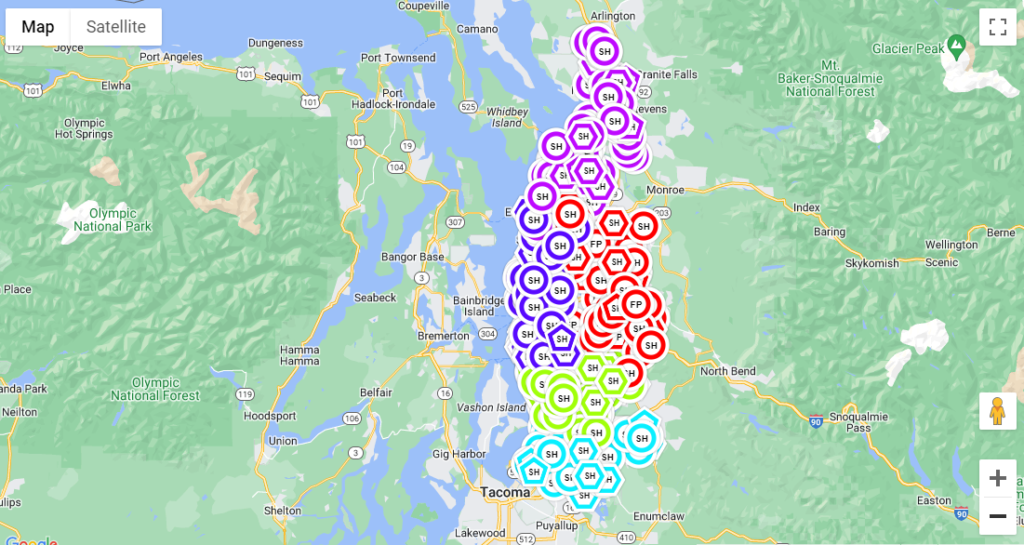
Example service area map: A pooper scooper service area should be large enough to support customer growth, but tight enough that routes can eventually become dense and profitable.
Swoop Scoop’s Approach to Service Areas
At Swoop Scoop®, we have generally been willing to start with a larger service area, then build route density over time.
That can work if you are disciplined about scheduling.
The key is that you cannot let every customer pick any service day they want.
If customers are spread across a larger area, you need to group them by route and assign service days based on location. Otherwise, your technicians will waste too much time driving back and forth across town.
For example, one part of the service area may be cleaned on Monday, another section on Tuesday, another section on Wednesday, and so on.
This allows you to serve a larger market without completely destroying route efficiency.
The long-term goal is simple: get more customers close together.
As your customer base grows, your routes should become tighter, faster, and more profitable.
Divide Your Service Area Into Route Days
Once you know the general area you want to serve, the next step is dividing that area into route days.
This is where many new pooper scooper businesses make a mistake.
They let customers choose any day they want.
That might feel customer-friendly at first, but it can create terrible routes. One customer might be on the north side of town, the next on the south side, the next back across town again.
That is how drive time gets out of control.
Instead, assign service days based on location.
For example:
-
North side: Monday
-
East side: Tuesday
-
South side: Wednesday
-
West side: Thursday
-
Overflow or flex route: Friday
The exact setup will depend on your market, but the principle is the same.
Customers should be scheduled based on route efficiency, not just preference.
You can still offer good customer service without giving every customer total control over the schedule. Most customers care much more that you show up consistently than whether you come on a specific day.
Why You Should Control Service Days
Controlling service days is one of the easiest ways to protect your profit.
If customers choose the schedule, your routes can become inefficient fast.
If you control the schedule, you can build density.
Route density helps you:
-
Reduce drive time
-
Lower fuel costs
-
Improve technician productivity
-
Fit more yards into each day
-
Reduce payroll waste
-
Make routes easier to train
-
Improve profit margins
This matters even more as you hire employees.
When you are doing the work yourself, inefficient routes are annoying. When you are paying technicians by the hour, inefficient routes directly cost you money.
If your technician is driving too much between yards, your labor cost goes up and your margin goes down.
That is why service area planning connects directly to pricing. If your routes are spread out, you may need to charge more to make the numbers work. For more on pricing, read our guide on how much pooper scoopers charge.
Do Not Offer Exact Arrival Times
For most pooper scooper businesses, exact arrival times are a bad idea.
You are not running a one-hour appointment business. You are running a route-based recurring service.
Weather, traffic, gate access, customer notes, dog behavior, and yard conditions can all affect timing. If you promise exact arrival times, you make your routes harder to manage and create unnecessary customer service issues.
Instead, give customers a service day.
You can let them know they are scheduled for Monday, Tuesday, or Wednesday, but avoid promising that you will arrive at 10:00 AM.
This gives your team flexibility to run the route efficiently.
It also makes it easier to add new customers, adjust route order, handle delays, and keep the day moving.
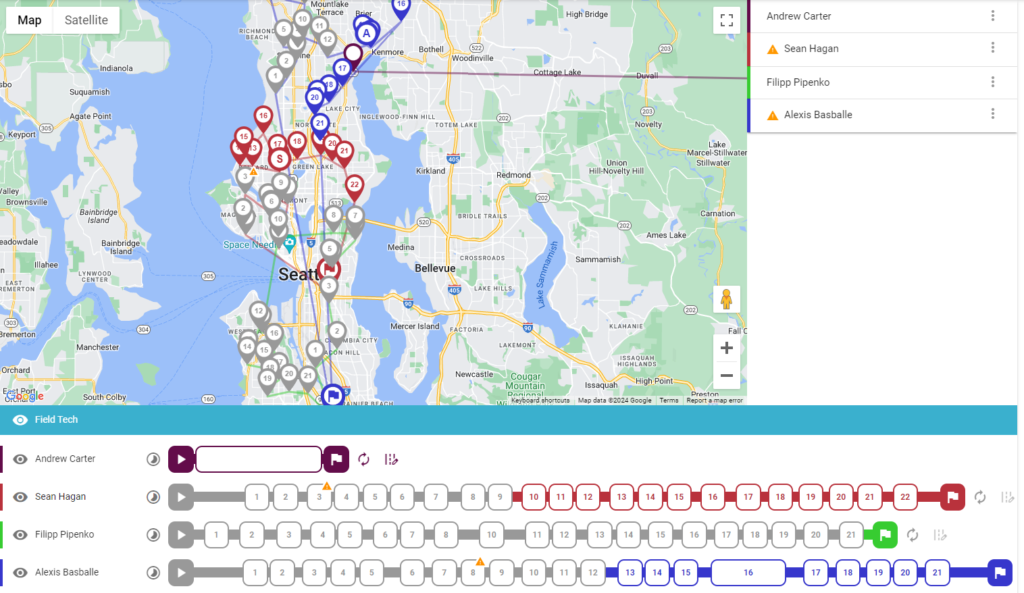
Example route planning: Route optimization tools can help visualize how customers are grouped, but the strategy still starts with choosing the right service area and controlling service days.
How Marketing Budget Affects Your Service Area
Your marketing strategy can influence how large your service area should be.
If you are relying mostly on low-cost local methods, such as referrals, local Facebook groups, door hangers, or personal outreach, you may be able to focus on a smaller area early.
If you are running paid ads, you may need a larger service area to give your campaigns enough people to reach.
Meta Ads and Google Ads usually need enough audience size and search volume to work well. If your service area is too small, your ads may struggle to spend or generate enough leads.
But there is a tradeoff.
A larger service area may help your ads perform better, but it can hurt route density in the short term.
That does not mean you should avoid paid ads. It just means you need to understand the operational cost of serving a larger area.
The best approach is usually to market broadly enough to get customers, then use scheduling, service days, and route planning to build density as you grow.
If you are still learning how to get customers, you can read our pooper scooper marketing guide or our guide on how to get your first 10 pooper scooper customers.
Common Service Area Mistakes
Choosing a service area is not complicated, but there are a few mistakes to avoid.
Serving Too Large of an Area Too Early
A huge service area can make your business feel bigger, but it can also create terrible routes.
If every new customer is 20 or 30 minutes away from the next one, your labor and fuel costs will eat into your profit.
Letting Customers Pick Any Day
This is one of the fastest ways to ruin route efficiency.
Give customers a service day based on location instead of letting them choose any day they want.
Not Tracking Where Customers Come From
Pay attention to which neighborhoods and cities are producing customers.
If one area is generating strong demand, focus more energy there. If another area is creating long drives for very few customers, you may need to pause marketing there or charge more.
Expanding Before Your Current Area Is Dense
Expansion sounds exciting, but density is where profit usually improves.
Before adding more towns or cities, ask whether you can get more customers in the areas you already serve.
Pricing the Same Everywhere
If one area is much farther away, harder to service, or less dense, it may need different pricing.
A customer 30 minutes outside your main route is not the same as a customer in a neighborhood where you already clean 20 yards.
Pooper Scooper Service Area FAQs
How large should a pooper scooper service area be?
A good starting point is a service area you can drive across in about 45 minutes or less. Then divide that area into route days where each smaller section can usually be crossed in about 15 minutes or less.
Should I start with a small or large service area?
Both can work. A smaller service area helps route density, while a larger service area gives you more people to market to. If you are running paid ads, you may need a larger audience. If you are trying to maximize efficiency, a tighter area is usually better.
What is route density?
Route density means having customers close together on the same route. Better route density reduces drive time, lowers labor costs, and helps technicians clean more yards in less time.
Should customers be allowed to choose their service day?
Usually no. It is better to assign service days based on location. This helps keep routes efficient and prevents your team from driving all over town.
Should pooper scooper businesses offer exact arrival times?
Usually no. It is better to offer a service day rather than an exact time. Pooper scooper routes are affected by traffic, weather, access issues, and yard conditions, so exact arrival times can make operations harder.
Can I expand my service area later?
Yes. Many pooper scooper businesses start with one core area, then expand as they gain customers, route density, technicians, and marketing systems. Just make sure expansion does not destroy profitability.
Get Help Building Your Pooper Scooper Business
Choosing your service area is one of the first real operating decisions you will make.
A smart service area helps you build route density, reduce drive time, protect profit margins, and scale more smoothly.
Inside Poop Scoop Millionaire™, we help pooper scooper business owners think through pricing, marketing, operations, routing, customer policies, and the systems needed to grow.
If you want to build your business with support from people who understand the pet waste removal industry, join Poop Scoop Millionaire™.