

Starting a pooper scooper business can be a great local service opportunity, but one of the first questions every new owner runs into is simple: how much should I charge?
If your prices are too low, you may stay busy but struggle to make a real profit. If your prices are too high for your market, it can be harder to get your first customers. The goal is to find pricing that is easy for customers to understand, profitable for your business, and realistic for the amount of dog waste, drive time, labor, and route density involved.
In this guide, we’ll break down how much pooper scoopers typically charge, how to think about weekly and monthly pricing, what to charge for extra dogs and initial cleanups, and how to build a pricing structure for your own pet waste removal business.
Quick Answer: How Much Do Pooper Scoopers Charge?
Most pooper scooper services charge around $20 to $35 per visit for weekly residential service, or roughly $85 to $150 per month for a standard recurring customer.
Prices usually depend on the number of dogs, how often the yard is cleaned, the size of the yard, the difficulty of the cleanup, and whether waste haul-away is included. For most new pet waste removal businesses, the easiest pricing model is a flat monthly rate based on service frequency and number of dogs.
| Service Type | Typical Price Range |
|---|---|
| Weekly residential service | $20–$35 per visit |
| Weekly monthly plan | $85–$150/month |
| Twice-weekly service | $140–$250/month |
| Every-other-week service | $60–$120/month |
| Initial cleanup | $60–$150+ |
| Large yard or heavy cleanup | Custom pricing |
These are general pricing ranges, not hard rules. Your actual prices should depend on your local market, service frequency, number of dogs, yard size, cleanup difficulty, route density, and labor costs.
For most average residential yards, the simplest pricing model is a flat monthly rate based on number of dogs and service frequency. Large yards, difficult terrain, or heavy initial cleanups should be priced higher.
What Do Pooper Scooper Companies Actually Charge?
Inside the Poop Scoop Millionaire™ community, we surveyed pet waste removal business owners about what their average residential customer pays each month.
The results showed a wide range, with companies charging anywhere from $65 per month or less to $116+ per month per residential customer. However, many responses clustered around the $86 to $105 per month range.
This lines up with what we see across the industry. Most recurring pooper scooper pricing is built around a monthly service plan, not a one-time cleanup fee. The exact price depends on the number of dogs, service frequency, yard size, local market, and how efficiently the company can route its customers.
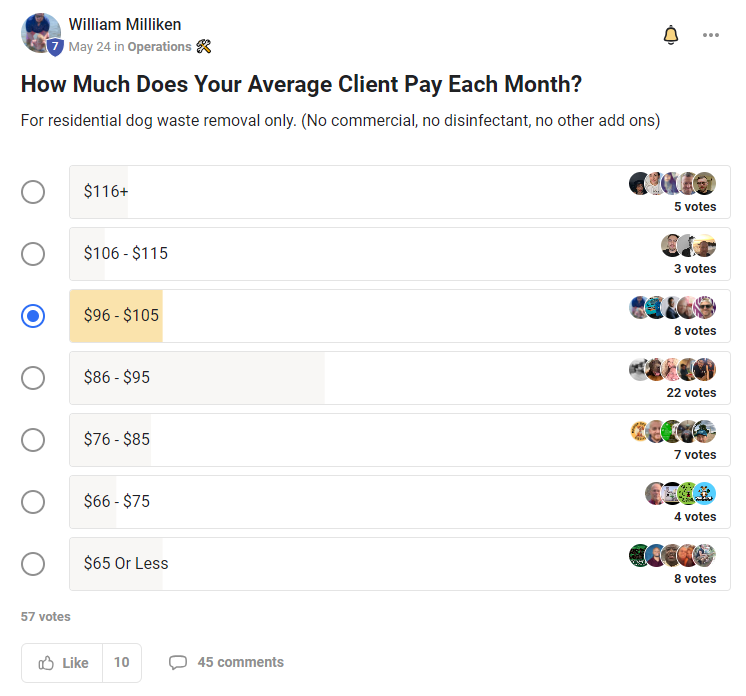
PSM community survey: Average monthly residential customer pricing among pet waste removal business owners.
Based on this survey and our own experience operating Swoop Scoop®, I would be cautious about pricing too low. Low prices may help you get a few early customers, but they can also hurt your profit margins and make it harder to hire employees, pay for marketing, cover overhead, and build a real business.
That does not mean you need to be the most expensive company in your market. It means your prices need to support the kind of business you are trying to build. If you want a deeper breakdown of revenue, profit margins, and earning potential, read our guide on how much money you can make with a pooper scooper business.
The Best Pricing Model for a Pooper Scooper Business
There are several ways to price pooper scooper service. Some companies charge per visit, some charge by the hour, some charge based on yard size, and others build custom quotes for every customer.
In our experience, the simplest pricing model is a flat monthly rate based on the number of dogs and the service frequency.
That works because most average residential yards are fairly similar. The two biggest factors are usually how many dogs are using the yard and how often the yard is being cleaned. More dogs means more poop. Less frequent service means more waste per visit.
You can still charge more for large yards, difficult terrain, heavy initial cleanups, or unusual situations. But for most residential customers, dog count and service frequency should do most of the pricing work.
This keeps your pricing easy for customers to understand, easier for your team to quote, and easier for your business to manage as you grow.
Pooper Scooper Pricing by Service Frequency
Service frequency is one of the biggest factors in pooper scooper pricing. The less often a yard is cleaned, the more waste there is to pick up during each visit.
For that reason, every-other-week service should usually cost more per visit than weekly service, even if the monthly price is lower. A customer who gets service once every other week is not just getting “half” of weekly service. Each visit usually takes longer because more waste has accumulated.
Here is a simple way to think about it:
| Service Frequency | How to Think About Pricing |
| Weekly service | Best standard option for most residential customers |
| Twice-weekly service | Higher monthly price, often used for multiple dogs or heavy-use yards |
| Every-other-week service | Lower monthly price, but higher per-visit price than weekly |
| One-time cleanup | Usually priced separately based on how much waste has accumulated |
For most pooper scooper businesses, weekly service should be the core offer. It is easier to route, easier to maintain, and usually creates a better customer experience because the yard stays consistently clean.
At Swoop Scoop®, close to 70% of our recurring customers are on weekly service. In our experience, weekly service is the easiest option for customers to understand and the easiest service frequency to build efficient routes around.
That does not mean every customer has to be weekly, but if you are starting a pooper scooper business, weekly service should probably be your main offer. You can still offer twice-weekly service for heavier-use yards and every-other-week service for price-sensitive customers, but weekly service is usually the foundation of a strong recurring route.
Pooper Scooper Pricing by Number of Dogs
The number of dogs in the household is one of the easiest ways to explain pooper scooper pricing to customers.
More dogs usually means more poop, which means more time in the yard and more work for your business. That is why most pet waste removal companies charge more for each additional dog.
A simple way to handle this is to start with a base price for one dog, then add a fixed amount for each additional dog. For example, if your weekly service starts at $25 per visit for one dog, you might charge an extra $5 per visit for each additional dog.
Here is a simple example:
| Number of Dogs | Example Weekly Price |
| 1 dog | $25 per visit |
| 2 dogs | $30 per visit |
| 3 dogs | $35 per visit |
| 4 dogs | $40 per visit |
This is only an example, not a rule every company should follow. Your additional dog fee might be higher or lower depending on your market, service frequency, labor costs, and how much extra time each dog typically adds to the cleanup.
For most average residential yards, charging based on dog count makes sense because it is easy for customers to understand. One dog creates less waste than three dogs, and a three-dog yard usually takes longer to clean than a one-dog yard.
You can also build this same logic into your flat monthly plans. Instead of quoting every yard from scratch, you can create a simple pricing structure where each additional dog adds a set amount to the monthly price.
How Much Should You Charge for an Initial Cleanup?
Initial cleanups should usually be priced separately from recurring service because the first visit often takes longer than a normal maintenance visit.
A weekly customer may only have a few days of waste in the yard, but an initial cleanup could include several weeks or months of accumulated dog waste. That means more time, more bags, more disposal, and more labor.
There are several ways to price an initial cleanup. Here is how I would rank them from best to worst:
| Initial Cleanup Pricing Method | How It Works |
| Free or discounted with recurring service | Reduce or waive the initial cleanup fee when the customer signs up for ongoing service |
| Flat rate based on historical averages | Charge a set initial cleanup fee based on how long cleanups usually take |
| Tiered flat rate | Charge different flat rates based on the condition of the yard, such as light, normal, or heavy cleanup |
| Hourly pricing | Charge based on how long the cleanup takes |
| Per-bag or per-bucket pricing | Charge based on how many bags or buckets of waste are removed |
My favorite option is offering a free or discounted initial cleanup when the customer signs up for recurring service. At Swoop Scoop®, we often use a free initial cleanup with regular service because it removes friction and makes it easier for customers to get started.
A free initial cleanup may sound expensive, but it is usually not as costly as it seems. If an employee is paid $25 per hour and the initial cleanup takes one hour, your direct labor cost may only be around $25. That is very different from thinking you “lost” the full $75 or $100 you could have charged.
If you do charge for the initial cleanup, I prefer using a flat-rate price based on historical averages. For example, if your average initial cleanup takes about 45 minutes and your goal is to generate around $100 per hour in revenue, you could charge a flat $75 initial cleanup fee. Some yards will take less time, some will take more time, but over time the numbers should average out.
Personally, I try to avoid hourly pricing whenever possible. It may feel like it protects your time, but it can create problems with the customer experience. Customers may start watching the clock, questioning how long the cleanup should take, or second guessing the value if they feel like they are paying close to $100 per hour for someone to scoop dog poop.
I like per-bag or per-bucket pricing even less because it sounds fair, but it can be inconsistent in the real world. A yard with one large dog may fill bags faster than a yard with two small dogs. Leaves, grass clippings, moisture, and how waste is collected can also change how many bags are used. That makes the pricing less standardized and can feel less fair to customers.
The main thing is to avoid treating the initial cleanup like a normal recurring visit. The first cleanup is usually the hardest visit, so your pricing should account for the extra work while still making it easy for a good recurring customer to say yes.
When Should You Charge More for Large Yards or Difficult Terrain?
For most average residential yards, you can usually price pooper scooper service based on the number of dogs and how often the yard is cleaned.
The main exception is yard size.
If a property is significantly larger than a normal residential yard, it takes more time to walk, inspect, and clean. In that case, it makes sense to charge more. For example, you might have a standard price that covers an average yard, then charge an extra $10 per month for each additional quarter acre above your normal yard size.
Difficult terrain can also justify a small surcharge in some cases. If the yard has steep hills, rocks, gravel, multiple separated dog areas, or other conditions that make the cleanup take noticeably longer, you may need to charge more.
Here is a simple way to think about it:
| Situation | How to Handle It |
| Average residential yard | Include it in your normal flat-rate pricing |
| Large yard or acreage | Add a monthly surcharge based on size |
| Difficult terrain | Consider a small surcharge if it noticeably increases service time |
| Heavy initial waste | Account for it in the initial cleanup |
| Multiple dogs | Account for it in your per-dog pricing |
The goal is to keep your pricing simple. Charge a clear flat rate for normal residential yards, build dog count and service frequency into your pricing, and only add surcharges when the property truly falls outside your normal service assumptions.
For normal conditions that are outside your scope of work, the best approach is usually to clean what you can without spending too much extra time. You are providing dog waste removal, not landscaping, yard cleanup, or property maintenance.
Common Pooper Scooper Pricing Mistakes to Avoid
Pricing a pooper scooper business does not need to be complicated, but there are a few common mistakes that can hurt your margins or make the business harder to grow.
The first mistake is pricing too low just to get customers. Lower prices may help you get started, but if your pricing does not support your labor costs, marketing, overhead, and profit margin, you may end up building a busy route that is not very profitable.
The second mistake is copying the cheapest competitor in your market. You do not need to be the most expensive company in town, but your pricing should be based on your costs, your route density, your service quality, and the kind of business you are trying to build.
Another common mistake is not charging enough for extra dogs or less frequent service. More dogs create more waste, and every-other-week service usually takes longer per visit than weekly service. Your pricing should account for that.
Finally, do not forget to review your prices over time. Labor costs, software, insurance, fuel, marketing, and overhead can all increase. If your prices never change, your margins can slowly shrink even if your customer count is growing.
Need Help Setting Prices for Your Market?
Pooper scooper pricing is not one-size-fits-all. A price that works in one city may be too low or too high in another market.
Your pricing should take into account your local competition, labor costs, service area, route density, number of dogs, service frequency, and how quickly you want to grow. That is why guessing or copying another company’s pricing is not always the best approach.
Inside Poop Scoop Millionaire™, members get access to Winston AI+, our AI business assistant trained on our pooper scooper business content, courses, resources, and real-world experience from building Swoop Scoop®.
PSM members can use Winston AI+ to help think through pricing for their specific market, including weekly service, extra dog pricing, initial cleanups, large yard surcharges, and other common pricing questions.
If you want help setting up your pricing, building your service offer, and growing your pet waste removal business, Poop Scoop Millionaire™ can give you the tools, training, and community support to make better decisions faster.