

Quick Answer: How Much Do Pooper Scoopers Make?
Pooper scoopers can make anywhere from a few hundred dollars per month as a small side hustle to $10,000 to $15,000+ per month in gross revenue as a full-time solo operator. A larger dog waste removal business with employees, multiple routes, and strong marketing can grow far beyond that.
The easiest way to estimate how much a pooper scooper business can make is to multiply your number of recurring customers by your average monthly customer value.
For example, if your average customer pays $100 per month, the math looks like this:
| Customers | Gross Monthly Revenue | Gross Annual Revenue |
|---|---|---|
| 25 customers | $2,500/month | $30,000/year |
| 50 customers | $5,000/month | $60,000/year |
| 100 customers | $10,000/month | $120,000/year |
| 150 customers | $15,000/month | $180,000/year |
These numbers are gross revenue, not profit.
Your actual take-home income depends on your expenses, route density, fuel costs, supplies, software, marketing, taxes, and whether you are doing the work yourself or hiring employees.
This is why pricing and route density matter so much. Two pooper scooper businesses can have the same number of customers, but the one with better pricing, tighter routes, stronger customer retention, and less wasted drive time will usually be more profitable.
How Much Can a Solo Pooper Scooper Earn?
A solo pooper scooper can make a solid part-time or full-time income, but there is a practical limit to how much one person can do by themselves.
If you are charging around $100 per month per customer, then a solo operator with 50 recurring customers is doing about $5,000 per month in gross revenue. At 100 recurring customers, that becomes $10,000 per month. At 150 recurring customers, that becomes $15,000 per month.
At Swoop Scoop®, we have found that one full-time scooper can often handle around 100 to 150 recurring customers, depending on route density, service frequency, yard conditions, and how much driving is involved.
That does not mean every solo operator will hit 150 customers right away. If your customers are spread out, your routes are inefficient, or you are also handling all the calls, billing, scheduling, and marketing yourself, your capacity may be lower.
This is why route density matters so much. A solo operator with 80 customers packed into tight neighborhoods may make more money and have less stress than someone with 120 customers spread across a huge service area.
For many people, the solo stage is where a pooper scooper business becomes a real income opportunity. You can start small, build recurring customers, keep expenses low, and decide later whether you want to stay solo or begin hiring employees.
How Much Can a Pooper Scooper Business Make With Employees?
Once you start hiring employees, a pooper scooper business can grow beyond what one person can clean by themselves.
A good way to think about growth is by route capacity. One trained pooper scooper can often handle around 100 to 150 recurring customers, which usually works out to roughly 20 to 30 yards per day once routes are built up and customers are grouped efficiently.
Using the same simple average of $100 per month per customer, one full route could represent around $10,000 to $15,000 per month in gross revenue.
That means the revenue potential starts to grow as you add more routes:
| Routes | Estimated Customers | Estimated Gross Monthly Revenue |
|---|---|---|
| 1 route | 100 to 150 customers | $10,000 to $15,000/month |
| 2 routes | 200 to 300 customers | $20,000 to $30,000/month |
| 5 routes | 500 to 750 customers | $50,000 to $75,000/month |
| 10 routes | 1,000 to 1,500 customers | $100,000 to $150,000/month |
At Swoop Scoop®, we have lived through this progression firsthand. We started with one scooper in 2020, then added routes, hired employees, expanded into multiple markets, and built the systems needed to support a larger operation.
Over the trailing 12 months, Swoop Scoop® has generated more than $3 million in sales from dog waste removal services across multiple markets.
That does not happen overnight, and it comes with a lot more complexity. Once you hire employees, you also have to manage payroll, vehicles, supplies, customer service, scheduling, training, quality control, marketing, and route efficiency.
But this is also where the business can become much bigger than a solo job. If you can build dense routes, hire reliable technicians, keep customers happy, and maintain strong pricing, a pooper scooper business can grow into a real local service company.
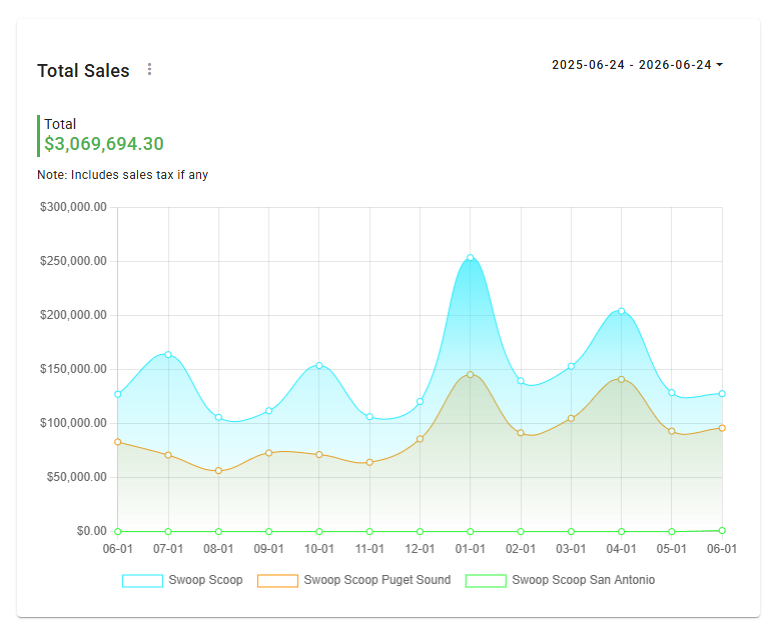
Swoop Scoop® generated $3,069,694.30 in total sales from June 24, 2025 to June 24, 2026, shown here inside our Sweep&Go multi-location dashboard.
What Are Typical Pooper Scooper Business Profit Margins?
Typical pooper scooper business profit margins can range from 15% to 40%, depending on pricing, route density, labor costs, marketing spend, and how efficiently the company is operated. A solo owner-operator may be able to keep 70% to 80% of revenue as profit in some cases, while a larger company with employees should often aim for around 30% net profit as a strong target.
The reason solo margins can look so high is that the owner is doing the labor. If you are the one scooping yards, answering calls, handling billing, building routes, and doing marketing, the business may look extremely profitable on paper because you are not paying someone else to do those jobs.
However, your time still has value. A solo pooper scooper keeping 70% to 80% of revenue may be earning great money, but they are also creating that profit with their own labor.
Once you start hiring employees, labor usually becomes one of the biggest expenses. In many pooper scooper businesses, labor can run around 25% to 40% of gross revenue, depending on pricing, employee pay, route density, payroll taxes, productivity, and how efficiently the company is managed.
Marketing is another major variable.
An established pooper scooper business with dense routes, strong reviews, referrals, and repeat customers may spend less than 5% of revenue on marketing just to maintain the business. But a company trying to grow aggressively in a new or competitive market may spend 15% to 20% or more of revenue on marketing.
For larger dog waste removal businesses with employees, profit margins can vary widely. In the pooper scooper industry, we commonly see business owners self-report margins anywhere from 15% to 40%. The companies on the higher end usually have better pricing, tighter routes, stronger customer retention, more efficient employees, and controlled marketing costs.
The biggest mistake is only looking at revenue. A business doing $50,000 per month with poor pricing, scattered routes, high labor costs, and expensive marketing may keep less profit than a smaller business with fewer customers but much better systems.
The goal is not just to get more customers. The goal is to build profitable recurring routes.
What Affects Pooper Scooper Business Income and Profit?
The amount of money you make with a pooper scooper business comes down to more than just how many customers you have. Revenue matters, but the real difference is how efficiently those customers turn into profit.
The biggest factors are:
Pricing: Higher average customer value gives you more room to pay for labor, fuel, supplies, marketing, software, and overhead. Underpricing can make the business feel busy without making it profitable.
Route density: The closer your customers are to each other, the more yards you can clean in less time. Tight routes usually mean better margins.
Customer retention: Recurring revenue is powerful, but only if customers stay. Reliable service, good communication, and a professional customer experience help keep customers longer.
Labor efficiency: Once you hire employees, how many yards they can clean per hour becomes one of the biggest drivers of profit.
Marketing costs: A mature business with strong reviews and referrals may spend very little to maintain its customer base, while a new or fast-growing market may require much heavier ad spend.
Service area: Expanding too wide too early can hurt profitability. It is usually better to build dense routes in a smaller area before spreading into too many cities.
Add-on services: Services like deodorizing or pet waste station service can increase average customer value, but the core scooping route needs to work first.
A profitable pooper scooper business is not just about getting more customers. It is about getting the right customers, at the right price, in the right areas, with systems that keep the routes efficient.
Is a Pooper Scooper Business Worth It?
A pooper scooper business can be worth it if you want a simple local service business with low startup costs, recurring revenue, and room to grow over time.
It is not glamorous work, and it still takes effort to get customers, build routes, answer calls, manage schedules, and provide consistent service. But the business model is easy to understand: customers pay you on a recurring basis to clean their yards so they do not have to pick up dog poop themselves.
For a solo operator, it can be a strong side hustle or full-time income opportunity. For someone willing to hire, train, market, and build systems, it can grow into a real local service company.
If you are still in the early research stage, we recommend starting with our full guide on how to start a pooper scooper business.
The key is not just getting customers. The key is building profitable routes with good pricing, strong retention, and efficient operations.
Frequently Asked Questions
How much do pooper scoopers make?
Pooper scoopers can make anywhere from a few hundred dollars per month as a side hustle to $10,000 to $15,000+ per month in gross revenue as a full-time solo operator. Larger dog waste removal businesses with employees and multiple routes can grow far beyond that.
Can a pooper scooper business make six figures?
Yes, a pooper scooper business can make six figures in annual revenue. For example, 100 recurring customers paying an average of $100 per month equals $10,000 per month, or $120,000 per year in gross revenue. Profit depends on expenses, pricing, route density, marketing, and labor.
How many customers can one pooper scooper handle?
One full-time pooper scooper can often handle around 100 to 150 recurring customers, depending on route density, service frequency, yard size, customer spacing, and how much admin work they are also doing.
How many yards can a pooper scooper clean per day?
A trained pooper scooper can often clean around 20 to 30 yards per day once routes are built up and customers are grouped efficiently. Routes with large yards, heavy buildup, or long drive times may be lower.
What is a good profit margin for a pooper scooper business?
A larger pooper scooper business with employees may aim for around 30% net profit, although results can vary widely. In the industry, we commonly see business owners self-report profit margins anywhere from 15% to 40%, depending on pricing, labor, marketing, and route efficiency.
Can a solo pooper scooper have higher profit margins?
Yes. A solo pooper scooper may have very high profit margins because they are doing the labor themselves. In some cases, a solo operator could keep 70% to 80% of revenue, but that profit is being created by their own time and labor.
What affects how much money a pooper scooper business makes?
The biggest factors are pricing, route density, customer retention, labor efficiency, marketing costs, service area, and add-on services. Getting more customers helps, but profitable routes matter more than customer count alone.
Is a pooper scooper business a good side hustle?
Yes, a pooper scooper business can be a good side hustle because startup costs are low, the service is simple to learn, and customers often pay on a recurring basis. Even 25 to 50 recurring customers can create meaningful monthly income.
Is a pooper scooper business scalable?
Yes, a pooper scooper business can be scalable if you can build dense routes, hire reliable technicians, maintain strong pricing, and keep customers happy. Once employees are involved, systems for routing, billing, training, customer service, and quality control become much more important.
How much can a pooper scooper earn part time?
A part-time pooper scooper business can realistically earn anywhere from a few hundred dollars per month to several thousand dollars per month, depending on pricing, route density, and how many recurring customers you service.
For example, if you have 25 recurring customers paying an average of $100 per month, that is about $2,500 per month in revenue. If you grow that to 50 recurring customers, that is about $5,000 per month in revenue. At that size, many owner-operators can still run the business part time if their routes are tight and they keep the service area simple.
The biggest factor is not just how many yards you clean. It is how close those yards are together, how efficiently you route them, and whether you are pricing high enough to make the time worthwhile.
What are the gross profit margins for a pooper scooper business?
Gross profit margins for a pooper scooper business are often around 50% to 75%, depending mostly on labor costs, pricing, and route density.
This is one of the reasons pet waste removal can be such an attractive local service business. Fuel, bags, disposal, and basic supplies are usually relatively small line items compared to labor. Once you have employees, your biggest direct cost is almost always the time it takes your team to drive the route and clean each yard.
The higher end of the margin range usually comes from strong pricing, dense routes, efficient scheduling, and keeping drive time low. The lower end usually happens when prices are too low, routes are spread out, or employees are spending too much time between jobs.
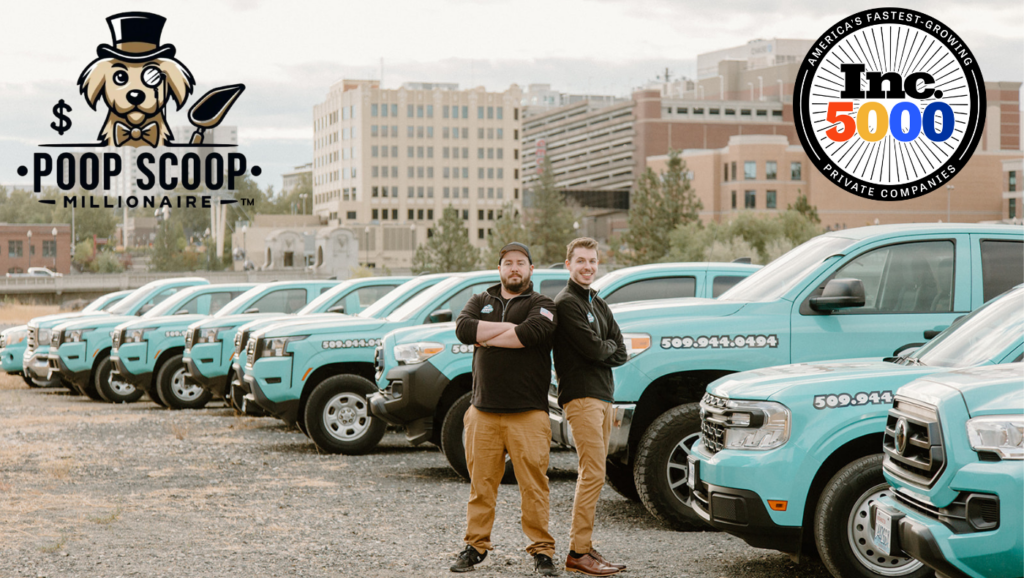
William and Levi from Swoop Scoop® and Poop Scoop Millionaire™, with part of the Swoop Scoop fleet after growing from one scooper into a multi-market dog waste removal company.
Want Help Building a Profitable Pooper Scooper Business?
If you want help starting or growing your own pooper scooper business, check out Poop Scoop Millionaire™.
Inside PSM, you get training, tools, live support, Winston AI+, and a community of other pooper scooper business owners learning and growing together.